The marine park and who runs it
The water around Bonaire has been protected since 1979, one of the oldest marine parks in the world. What that means for a diver is set out below.
The consequence for a diver is small and absolute: touch nothing, take nothing, do not anchor, no gloves without an exemption. Anyone who has not dived on Bonaire for over a year does an orientation dive with a dive school first. That is not a formality but the way the park passes on its rules.
- STINAPA Bonaire, about the parks
- Bonaire National Marine Park, management plan, 2023
- Ramsar Sites Information Service, Lac and Klein Bonaire
- Sea Turtle Conservation Bonaire, monitoring and nest counts
- Reef Renewal Bonaire, nurseries and outplanting
Three species, two life stages, one island
Anyone diving or snorkelling on Bonaire will almost certainly see a turtle. That is no accident: the island has both the seagrass beds where young animals grow up and the reefs where adults forage, a few kilometres apart.
As an adult it eats almost nothing but seagrass and algae. Young animals grow up for years in the shallow bays before moving to open water. This is the species you see grazing with its head in the grass.
Eats sponges and stays on the reef slope. Recognisable by the narrow, beak-like mouth and the overlapping scutes. Critically endangered worldwide; Bonaire’s reef is one of the places where the species is still ordinary.
The heaviest head of the three, with powerful jaws for shellfish. Nests here irregularly and is only rarely seen underwater.
Nest numbers swing sharply from year to year and from beach to beach; one good or bad season says little about the trend. We therefore give no annual total and point to the multi-year counts of the monitoring organisation.
What you see, and at what depth you see it
Bonaire’s reef starts so close to shore that snorkellers and divers largely see the same species, only at different depths. Below are the species you meet on almost every dive or snorkel, arranged by where they hold.
Black and yellow stripes, in shoals just below the surface. The first fish you see.
Deep blue, grazing on algae in loose groups. Juveniles are bright yellow.
Yellow-striped, hanging still in shoals by coral heads during the day.
Small and everywhere; cleans larger fish at cleaning stations.
Long and thin, hanging vertically among gorgonians so as not to stand out.
Silver with a yellow stripe and tail, curious around snorkellers.
Audibly nibbles at coral and so produces much of the white sand.
Yellow and blue with a crown mark on the forehead; usually in pairs.
Black with yellow scale edges, lets divers come close.
An eye spot at the rear that puts predators on the wrong foot.
Triangular and slow, looking for morsels in the sand between the coral.
In crevices, mouth open to breathe — no threat, but keep your distance.
Purple-blue clouds feeding in the current above the reef edge.
Electric blue, in loose swarms just above the coral.
Dark with pale fin edges; curious and often keeps station near divers.
A large grouper that waits motionless by a coral head for something to pass.
A silver giant up to two metres; hangs in the shade by day, hunts at dusk.
In fast groups along the reef edge, often hunting above a shoal of small fish.
Stands upright out of the sand like grass and vanishes as soon as you approach too fast.
Hovers above its burrow; the male broods the eggs in his mouth.
A flatfish with blue rings that buries itself in the sand; easily overlooked.
Lies half under the sand and forages at night. Never swim after it.
Spotted, with a long tail; usually passes by out in the blue.
Lies motionless on the sand until it strikes in a single movement.
What you have to look longer for
These species are there, but only if you dive slowly and know where to look. A torch helps, even by day.
Looks like a sponge, does not move. Often reported at Bari Reef, La Machaca and Ebo’s Special.
Tail curled around a gorgonian or sponge base. Do not touch and no close-up flash.
Perfectly camouflaged on the bottom, with venomous spines. Watch where you put your hand — or put it nowhere.
Crawls over the sand between the coral heads during the day.
In an anemone, at a cleaning station where big fish queue up.
Mostly at night, betrayed by a heap of empty shells outside the den.
After sunset the cast changes: parrotfish sleep in a mucus cocoon, lobsters and brittle stars come out of the crevices, squid hunt along the jetties and tarpon use your light to hunt. Do not shine your light into the eyes of sleeping fish, and let the tarpon do their work.
The lionfish (Pterois volitans) does not belong here and has no natural predators. It eats juvenile reef fish in large numbers. On Bonaire it is actively culled by divers with a permit and a special spear; without that permit you may not hunt. If you see one, report the place and depth to STINAPA or your dive school.
Fire coral, scorpionfish and bristle worms teach the lesson themselves to anyone who has touched them once. Do not feed fish, not even bread: fed morays and tarpon lose their shyness and bite sooner. And keep your fins up above the reef; most damage comes not from hands but from feet.
Why this reef is still standing, and what gnaws at it
Bonaire has counted for decades as one of the best-preserved reefs in the Caribbean. That is less a natural wonder than an administrative choice: early protection, no anchors, no net fishing on the reef. It does not make the reef immune — only less damaged than its neighbours.
What weighs on the reef
When sea temperature stays high, coral expels its algae and bleaches. Recovery is possible, provided the water cools in time and no second heatwave follows. Bonaire took heavy bleaching in 2010 and again during the Caribbean heatwave of 2023.
Stony coral tissue loss disease affects dozens of species and moves fast. It travelled through the Caribbean from 2014; sources differ on the year Bonaire had its first confirmed cases. Divers are asked to disinfect gear between islands.
The mass die-off of the black sea urchin Diadema in 1983 removed one of the most important grazers; in 2022 a new die-off hit Caribbean populations. Where grazers disappear, algae gain ground on coral.
Runoff from unpaved roads, building sites and waste water brings sediment and nutrients onto the reef. That feeds algae and smothers young colonies — a land problem with its outcome underwater.
In nurseries along the west coast, fragments of staghorn and elkhorn coral grow on hanging structures, to be placed back on the reef after a year. It works for fast-growing branching species and it is no substitute for a healthy reef: outplanting does not solve warm water or runoff. Some nurseries sit near well-known dive sites; stay outside them, even where there is no buoy.
What grows here, and how to tell it apart
You recognise coral by its growth form, not by its colour — that varies with depth and light. Four groups together make up almost everything you see standing on Bonaire’s reef.
A round boulder with winding grooves. Grows a few millimetres a year; a boulder a metre across is a century old.
Thick, domed colonies with large polyps that stand out at night like flowers.
Builds columns and terraces on the slope. Was once the most important reef builder in the Caribbean.
Thin, undulating plates overlapping like leaves; mainly in sheltered spots.
Upright pillars, rare and protected. Visible at Petries Pillar.
Broad antler branches in the surf zone. Largely gone since the eighties; still standing at Boka Bartol and Nukove.
Thin, branching arms. Grows relatively fast and is therefore the main species in the nurseries.
Thick, blunt fingers on the reef top; juvenile fish shelter between them.
Not a true coral but a hydroid. Mustard yellow with white edges, stings on contact.
A purple fan that grows at right angles to the current. Breaks easily and takes years to recover.
Feathery plumes that make the reef top sway in a light current.
Thick, upright fingers with short polyps; feels leathery, do not touch.
Despite the name it is white to brown; the skeleton beneath is black. From twenty-five metres down, decades old.
A barrel over a metre wide, hundreds of years old. Two divers fit beside it, not inside it.
Bundles of long purple tubes on the deeper slope; the hallmark of the walls of Klein Bonaire.
Broad orange plates in overhangs, often with brittle stars on them.
Grey-brown spheres on the reef top; filters thousands of litres of water a day.
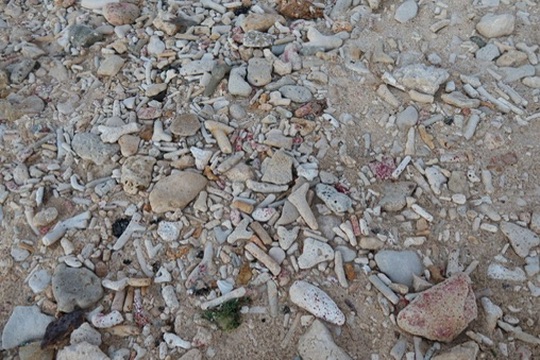
What ends up on the beach from the reef: broken finger and fire coral, shell and stone. Own photograph.
On a few nights a year, usually in the weeks after full moon in September and October, whole colonies release eggs and sperm at once. The water fills with pink bundles drifting to the surface. Researchers collect those gametes to raise larvae in the lab. If you dive through it: touch nothing and keep your light low.
A dry island waiting for rain
Bonaire gets roughly five hundred millimetres of rain a year, nearly all of it between October and January. The vegetation is built for that: thorny, slow, with roots reaching deeper than the plant stands high. After a good downpour the island is green within a week.
Grows leaning to the south-west under the constant trade wind. The island’s best-known natural compass; the pods were once exported for tanning leather.
Stands bare all year and then flowers bright yellow all at once, a few days after heavy rain. The name means axe-breaker: the wood is rock hard.
Lignum vitae, with blue flowers and wood that sinks in water. Cut for centuries for ship bearings; old specimens are rare and protected.
Stands on stilt roots in the brackish water of Lac. Nursery for reef fish and coastal defence in one.
The thorny mesquite that fills much of the interior. Goats eat the pods and so spread the seeds.
Calabash tree with fruits once used as bowls and musical instruments.
Columnar cactus up to nine metres. The fruit is edible and the stems go into the traditional soup; old trunks served as fencing.
A thinner columnar cactus, planted close together as a living fence around kunukus.
Pad cactus with yellow flowers and fine barbs that are worse than the large spines.
A globe cactus with a red cap on top. Protected; do not dig it up and do not sit on it.
Broad seagrass in the shallow bays; the main food of the green sea turtle.
Thinner seagrass standing among the turtle grass; together they form the nursery of Lac.
Round leathery leaves just behind the high-water line; holds the sand in place.
Low, fleshy plants around the brine pans, one of the few species that survive there.
Grown on a large scale in the nineteenth and twentieth centuries; still found gone wild along the roads.
A large shade tree by old kunukus, with sour pods for syrup and drinks.
The grain of the kunuku, grown behind walls of stacked stone that hold the rainwater.
The island has no seasons but showers. If heavy rain falls in October or November, the kibrahacha flowers within a week and the interior turns green; if the rain stays away, everything stays grey and thorny. Anyone coming in the dry months sees the same island in a different state, not in a worse one.
- Flora of the Dutch Caribbean, species accounts for Bonaire
- STINAPA Bonaire, vegetation and management of Washington Slagbaai
- Wageningen Marine Research, seagrass beds of Lac Bai
- Meteorological Service Curaçao and Bonaire, long-term rainfall series Flamingo Airport
Birds, lizards and what has been released
Bonaire has no native land mammals of note; what walks around was largely brought by people. The birds and reptiles are from here, and a number occur nowhere else.
Breeds in the Pekelmeer, one of the few breeding sites in the Caribbean. The breeding ground is closed: watch from the road and use no drone.
The yellow-shouldered amazon, loud in the early morning and evening. Occurs in only a handful of places in this hemisphere.
A smaller parakeet, in small groups around the kunukus and the town.
Orange and black, with a hanging nest and a whistling call you hear everywhere.
The mockingbird that comes to eat on your terrace and imitates other birds.
The bananaquit: small, yellow and immediately at every sugar bowl.
A bird of prey that walks along the road and eats carrion; often seen in the north.
In the salinas and mangroves of Lac, together with migrating waders. The scarlet ibis is only a rare vagrant here.
Up to a metre and a half including tail. Eaten in soup on the island; used to visitors at car parks — do not feed.
A small tree lizard found only on Bonaire. The male raises an orange throat fan.
The fast racerunner that darts under the bushes everywhere. The male turns blue — hence the name.
A small gecko on walls and tree trunks, active in the evening around lamps.
The island’s only snake species: twenty centimetres at most, harmless, eats termites and ants. Probably introduced by people. There are no boas or other large snakes on Bonaire — those are on Aruba — and no sea snakes swim in the water.
Eight to nine species depending on the source: one fish-eater, five insect-eaters and two nectar feeders. The nectar feeders are the only animals that pollinate the columnar cacti — without them, no kadushi. They roost in caves; visit those only with a guide.
Brought in the seventeenth century as pack animals, now gone feral. They walk loose along the roads in the south: drive slowly at night.
The greatest pressure on the vegetation: without fencing, young trees never get above knee height.
Land crabs that cross in numbers after rain; some roads have warning signs.
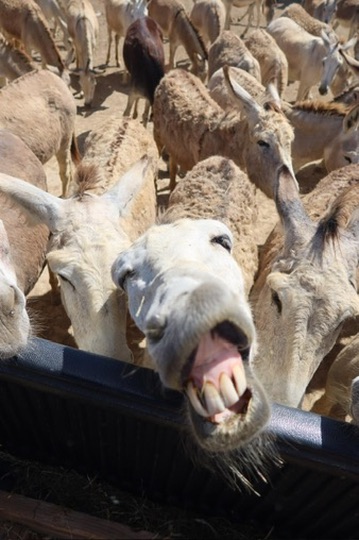
The donkeys were brought in the seventeenth century as pack animals and released after the salt works. Some still roam free in the south, some live in the sanctuary. They are used to people and come up to cars — feeding them makes that worse, not better. Own photograph.
Feed nothing, not even an iguana or a donkey: fed animals start begging from people and end up on the road. No drones above the flamingos or the breeding ground. Drive at walking pace where donkeys walk and give goats no leftovers. Report an animal hit by a car to the Donkey Sanctuary or STINAPA.
- Dutch Caribbean Nature Alliance, species lists for Bonaire
- Echo Bonaire, research on and protection of the lora
- STINAPA Bonaire, bird counts and the Pekelmeer flamingo breeding ground
- Carib Herp / IUCN Red List, reptile distribution data
The mosquito decides your evening
The island has few insects that bother you, but the ones that do, do it thoroughly. Almost everything turns on rain: once water falls, there is mosquito brood within two weeks.
The yellow fever mosquito (Aedes) bites by day and at dusk and breeds in small standing water: a bucket, a plant saucer, an old tyre. Culex is the evening and night mosquito. Numbers peak after the rains of October to January.
Nearly invisible, bites at sunrise and sunset, above all near the mangroves and salinas. Mosquito netting does not stop them — they fit through it.
Everywhere there is food. A trail across the counter within the hour is normal, not a sign of dirt.
The brown ball-shaped nests in trees and on posts are termites. They eat dead wood and are the main meal of the silver snake.
Two small species. A sting hurts like a wasp sting and is not dangerous to healthy adults. Shake out shoes that stood outside.
The large, flying kind. It belongs to the climate, not to the hygiene of your accommodation.
They appear in numbers after rain; the yellow monarchs are the most conspicuous. Dragonflies over the salinas hunt mosquitoes.
They pollinate the kadushi flowers by day; the bats take the night shift.
- Public Entity Bonaire, Public Health department: vector control and mosquito nuisance
- Dutch Caribbean Nature Alliance, insect species lists
- Meteorological Service Curaçao and Bonaire, monthly rainfall